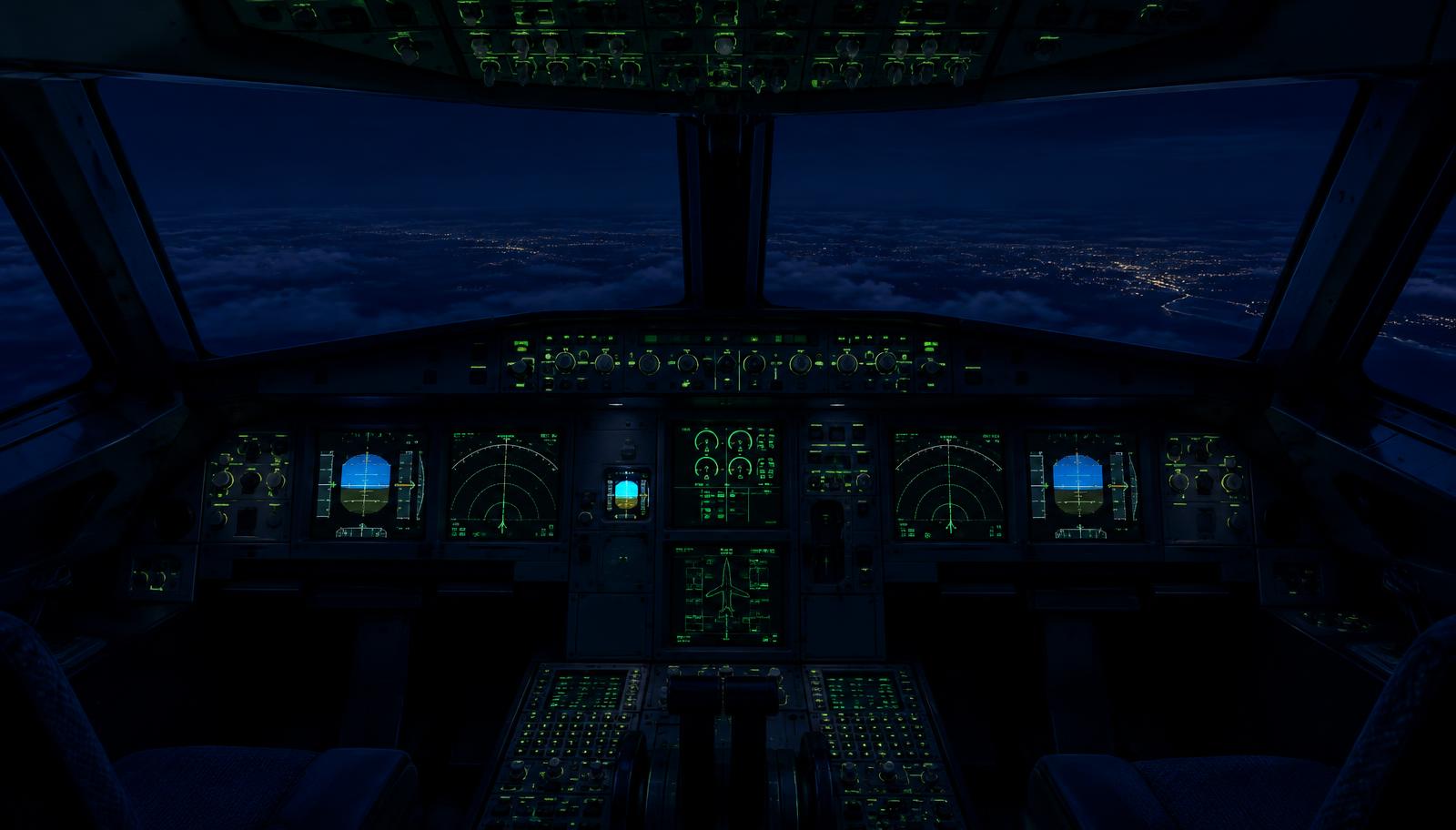
Simulation · Aviation training
Simulation in the service of aviation training
Pilots and maintenance technicians increasingly train on simulated devices. This site explains what these tools cover, what they enable, their limits and how to integrate them into an approved training programme.
Flight simulators (FSTD)
FFS, FTD, FNPT: definitions and qualification logic under EASA CS-FSTD.
Learn more →
Maintenance simulation
CBT, virtual and augmented reality, digital twins, procedure trainers.
Learn more →
Part-147 / ATO integration
Needs analysis, choice of means, approval and monitoring of training effectiveness.
Learn more →
/ Why simulate?
Simulation makes it possible to practise situations that are rare, costly or dangerous to reproduce on a real aircraft: failures, degraded conditions, emergency procedures, work on systems unavailable in the hangar.
It makes training repeatable and observable: the instructor can freeze, replay and analyse a sequence.
/ Benefits
- Safety: errors have no consequence for people or equipment.
- Availability: training does not depend on grounding an aircraft.
- Standardisation: identical scenarios for all trainees.
- Traceability: session recording supports competence monitoring.
- Coverage of rare cases: failures and abnormal situations.
/ Limits
- Partial fidelity: no device reproduces everything (sensations, gestures, environment).
- Bounded regulatory credits: the share of training achievable in a simulator depends on the device type, its qualification and the approved programme.
- Costs of acquisition, updates and maintaining qualification.
- Risk of negative transfer if the device differs from the aircraft and the gap is not addressed in training.
- Specific instructor competences are required.
i4M · AeroPlanAI
Designing digital modules and planning training
i4M supports organisations in designing digital training modules. Scheduling of sessions, instructors and resources can be organised with AeroPlanAI.
Discover AeroPlanAI →EASA
This site presents general concepts. Only official EASA publications (regulations, CS, AMC and GM) are authoritative.
See the texts on the EASA website →